Saturday, February 20, 2010

Gender, Health, and Environment


Following up on the discussion on NAFTA, we will be looking at the maquiladora industry more in depth, with a focus on gender roles, health, and environmental degradation. For your reading assignment, there are two articles to read. The first is "Women, Migration, and Household Survival Strategies: Mixtec Women in Tijuana," by Laura Velazco Ortiz, from the book Women and Migration in the U.S.-Mexico Borderlands. This reading is important as it gives insight on the rural populations that migrate to the border, which includes indigenous groups like Mixtecs. In contrast, the film we will be watching in class presents a different group of women working in the maquiladoras. These women come from urban areas around Mexico and are generally more educated and skilled, as the article will mention.

The second reading is an "Environmental Justice Case Study," which provides an introduction to environmental issues around the maquiladora industry. This article mentions the case of our community partners in Tijuana (Metales y Derivados), which also appears in the film.

Please respond with a blog comment to these readings, either one or both, with a paragraph after this post. Are there any questions that you still have after these readings?

Sunday, February 14, 2010

Midterm Books


For the midterm, we ask that you choose a book from the following list. Each book is a work of non-fiction that serves as a more personal account of life at the border or the life of immigrants and will aid you to undestand the issues that we study academically. On the day of the midterm, come prepared to present your book and what you've learned with this personal account of the US-Mexico border. Hopefully you can find the book in the library or at a bookstore. If you find another memoir that you would like to read, please let us know so we can check it out. Please COMMENT below with the book you'd like to read - do not choose a book another person has already selected. Thanks, and happy reading!

Crossing Over: A Mexican Family on the Migrant Trail
Ruben Martinez


Coyotes: A Journey Across Borders With America's Illegal Migrants
John Annerino


Dead in Their Tracks: Crossing America's Desert Borderlands
John Annerino


The Devil's Highway: A True Story
Luis Alberto Urrea


Enrique's Journey
Sonia Nazario


Journey of Hope, Memoirs of a Mexican Girl
Rosalina Rosay


Diary of an Undocumented Immigrant
Tianguis Pérez, Dick J. Reavis


Across the Wire: Life and Hard Times on the Mexican Border
Luis Alberto Urrea


Undocumented in L.A.: An Immigrant's Story
Dianne Walta Hart


Lives on the Line: Dispatches from the U.S.-Mexico Border
Miriam Davidson


The Short Sweet Dream of Eduardo Gutierrez
Jimmy Breslin


By The Lake of Sleeping Children: The Secret Life of the Mexican Border
Luis Alberto Urrea, John Lueders Booth

Politics, Economics, and Transnational Power


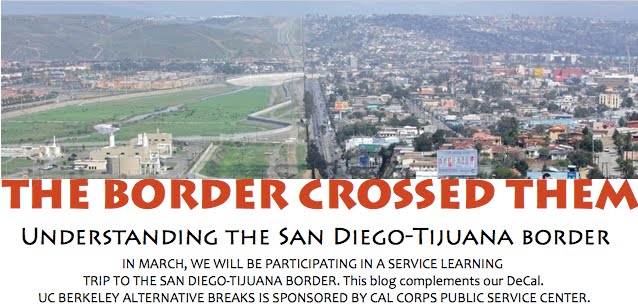
This week we will transition from history into contemporary and multidisciplinary issues around politics, economics, and transnational powers. Some of these issues have been a result of history. For example, NAFTA went to efect in 1994 as a development of neoliberal president Carlos Salinas. Even physically, the way the border looks has been a result of political events and actions, such as Operation Gatekeeper. Politics and economics are largely interrelated with society and migratory patterns, and from southern mexico, to the the northern border, effects are noticeable. We will discuss why people migrate in the first place, a major factor being the economy and the rise of free trade and biotechnology. The communities that we will be visiting during our trip are representations of these political and economic processes whose inhabitants rely on maquiladoras for work and are for the most part newcomers from around Mexico.

Your reading for this week is Happily Ever Nafta, a collection of four articles of commentary on the North American Free Trade Agreement. After this reading, what are your thoughts on NAFTA and in what ways has the border region been shaped by this trade agreement? You can answer this question or COMMENT with any other sort of response, about a paragraph in length. Another idea is looking for current articles on the progress of NAFTA. Where are we today? What is the future of NAFTA? This article might be beneficial to understanding NAFTA's background and provide a simple introduction to the assigned reading, in case you are new to NAFTA.

Thursday, February 4, 2010

Histories of the Border


Next class, we're very lucky to have guest speaker Michael Dear. Professor Dear is a newly-appointed professor of City and Regional Planning at the College of Environmental Design. He completed a multi-year 4,000-mile trip along the U.S.–Mexico border and uses this experience to reflect on the current and future status of the line between the two countries. We are hoping that Professor Dear will provide his personal insight on past and present events of the border.

To prepare for this discussion, have a look at this assigned reading handed out last Wednesday. This reading will give you a very brief break down of what the current Mexico-U.S. relationship looks like. Mexico history and U.S. history are heavily intertwined and the border is surely a result of hundreds of years of political, economic, and social processes between the two countries. Notice how even this introduction notes the importance of history.

In addition to this reading, check out this PBS timeline. Pick an event and come to class prepared to tell us a little about it. We recommend looking at outside resources. We hope that you will be able to connect this event to the reading: Can you trace any effect this event has had on present border issues or U.S.-Mexico relations? Why is this event important for us to know?

Please do not choose the NAFTA 1994 event, as we will be talking about this in the following class, though of course, your input is more than welcome then!

COMMENT after this post with your event of choice, in order to avoid people doubling on events, if possible, before Sunday.

This assignment is due Wednesday, February 10th.

SYLLABUS

This is a link to the course syllabus, including our community partner list and tentative itinerary.

We will keep it updated, so check back occasionally.

Friday, January 9, 2009

Border Patrol Shutting Down Friendship Park

Elliot Spagat, Associated Press

(01-09) 04:00 PST Imperial Beach, San Diego County -- The half-acre plaza where throngs gather on weekends to pass kisses, tamales and communion wafers through a chain-link fence to Mexico is closing. The California State Parks Department confirmed Thursday that the Border Patrol is shutting Friendship Park to make way for a triple fence.

The Border Patrol told local authorities Tuesday that the area would be closed to the public, said Clay Phillips, superintendent of Border Field State Park, which surrounds the Friendship plaza.

From the Mexican side, visitors on Thursday saw that crews had already torn up cement. Some trees were gone.

Friendship Park, which separates Imperial Beach from Tijuana, Mexico, was dedicated by first lady Patricia Nixon in the 1970s as a symbol of binational goodwill. It is a federal enclave in the southwestern corner of the continental United States, accessible to pedestrians and motorists only by going through the 800-acre state park.

continue reading...

Thursday, November 13, 2008

Some border theory to chew on...

"Closer critical scrutiny of borders challenges their reification and reveals them as far from simple. Instead, they appear inherently contradictory, problematical, and multifaceted. They are at once gateways and barriers to the "outside world", protective and imprisoning, areas of opportunity and/or insecurity, zones of contact and/or conflict, of co-operation and/or competition, of ambivalent identities and/or aggressive assertion of difference. These apparent dichotomies may alternate with time and place, but - more interestingly - they can coexist simultaneously in the same people, some of whom have to regularly deal not with one state but two."

Anderson and O'Dowd, 1999
From their article "Borders, Border Regions and Territoriality: Contradictory Meanings, Changing Significance".